🇫🇷 French AGEC Law Compliance

Gprs [2021] May 2026

Automatically generate compliant French sorting labels with the correct Triman logo, component pictograms, and bin colors based on your packaging type.

What is Info-Tri?

Info-Tri is France's mandatory sorting label system under the AGEC Law (Anti-Waste for a Circular Economy). It tells consumers exactly how to sort each component of your packaging.

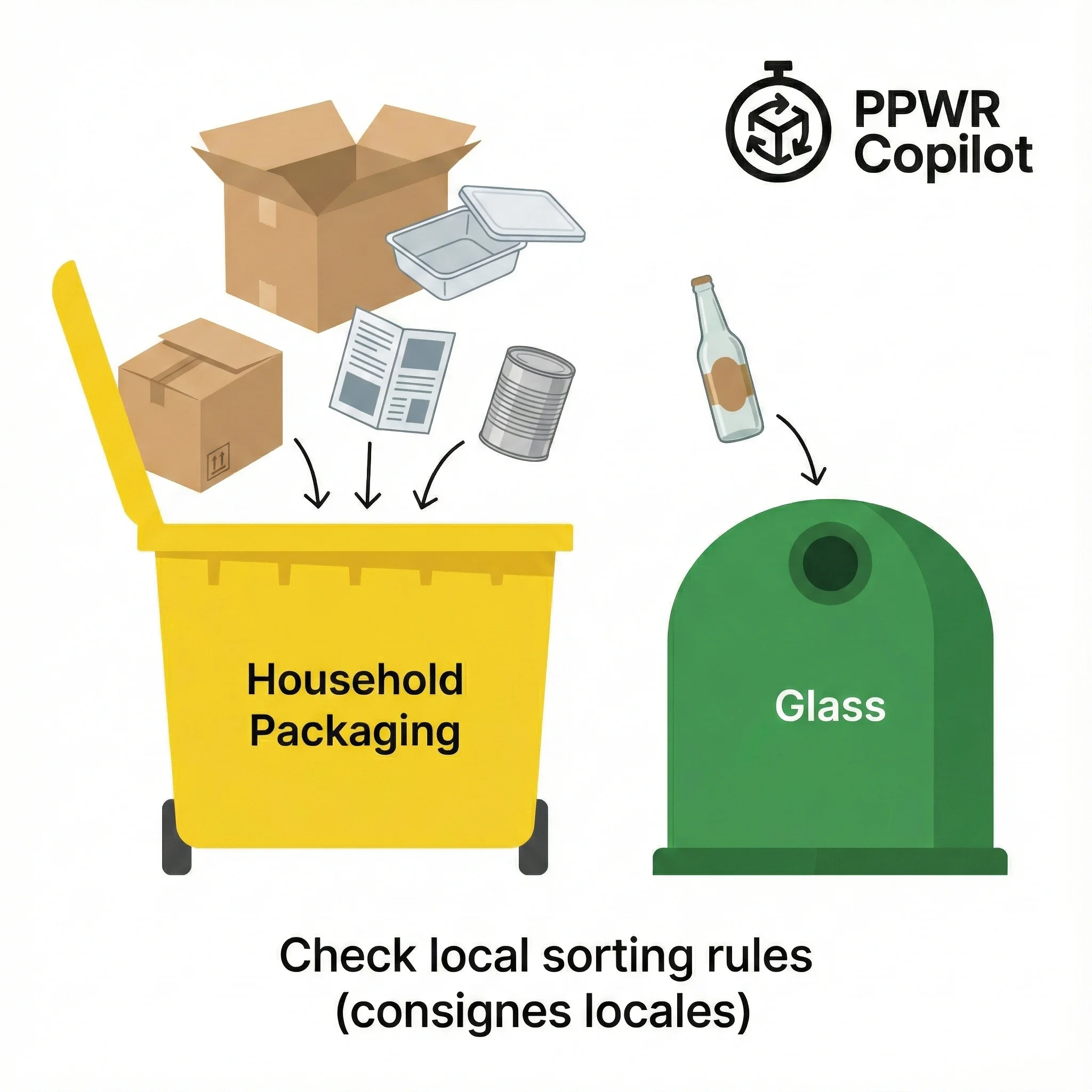
Illustration showing French sorting at a high level: household packaging into the yellow bin and glass into a bottle bank. Check local sorting rules (consignes locales).

Illustration for guidance only — always follow local sorting instructions (consignes locales).

Required Elements

  • 1
    Triman Logo

    The official French recycling symbol indicating the product is subject to sorting rules.

  • 2
    Component Pictograms

    Visual icons showing each separable component (bottle, cap, label, box, etc.).

  • 3
    Bin Color Indicator

    Yellow bin for most recyclables, green bin for glass containers.

♻️

Example Info-Tri label showing Triman logo with bottle and cap pictograms pointing to yellow bin.

Packaging Types We Support

Select your packaging format and we automatically generate the correct Info-Tri pictograms.

🍾

Bottle + Cap

Plastic or glass bottles with separate cap pictogram

🫙

Jar + Lid

Glass jars with metal or plastic lid component

📦

Cardboard Box

Shipping boxes and product cartons

🧴

Tube

Cosmetic and pharmaceutical tubes

🥤

Carton

Beverage and food cartons (Tetra Pak style)

🛍️

Pouch/Film

Flexible pouches and film packaging

🥫

Can

Metal cans for food and beverages

💊

Blister Pack

Pharmaceutical and consumer blister packs

Gprs [2021] May 2026

In its prime, GPRS offered theoretical speeds up to 114 Kbps, though real-world speeds were usually closer to 35–40 Kbps.

Professionals could sync their BlackBerries and check work emails on the go. GPRS vs. EDGE: The Next Step

Before GPRS, mobile data was limited to simple text. GPRS enabled a whole new world of services: In its prime, GPRS offered theoretical speeds up

The Evolution of Connectivity: Understanding GPRS In the early days of mobile technology, phones were primarily for talking. If you wanted to access the internet, you had to deal with agonizingly slow "circuit-switched" connections that charged you by the minute. Everything changed with the introduction of .

While 4G and 5G have made GPRS feel like a relic for smartphones, it hasn't disappeared. Because of its incredible range and low power consumption, GPRS is still widely used in devices. You can often find it powering: Utility meters (smart meters) GPS tracking devices for fleets Basic credit card terminals in remote areas Conclusion EDGE: The Next Step Before GPRS, mobile data

Walkie-talkie style communication over cellular networks.

GPRS was the first technology to fully integrate mobile devices with the Internet Protocol (IP), allowing phones to act like mini-computers on the web. What was GPRS used for? Everything changed with the introduction of

As the demand for data grew, GPRS evolved into (Enhanced Data rates for GSM Evolution), often called 2.75G . EDGE used the same underlying infrastructure but squeezed more data into the same radio frequencies, effectively tripling the speeds of standard GPRS. Is GPRS Still Relevant?
How Our Generator Works

Three steps to compliant French packaging labels.

1

Select France

Choose France as one of your target markets in the dashboard. You can select multiple EU countries in one dossier.

2

Choose Packaging Type

Select your packaging format (bottle, jar, box, pouch, etc.) and we automatically pick the right pictograms.

3

Download Your Dossier

Your PDF includes a dedicated Info-Tri section with Triman logo, component pictograms, and correct bin color.

Generate Your Info-Tri Labels Now

Start your free 7-day trial. Generate up to 5 France-compliant dossiers at no cost.

Start Free Trial